Drama Triangle to Empowerment Triangle

Do you find yourself stuck in patterns where you feel powerless, emotionally exhausted, overly responsible for others, or resentful in relationships?
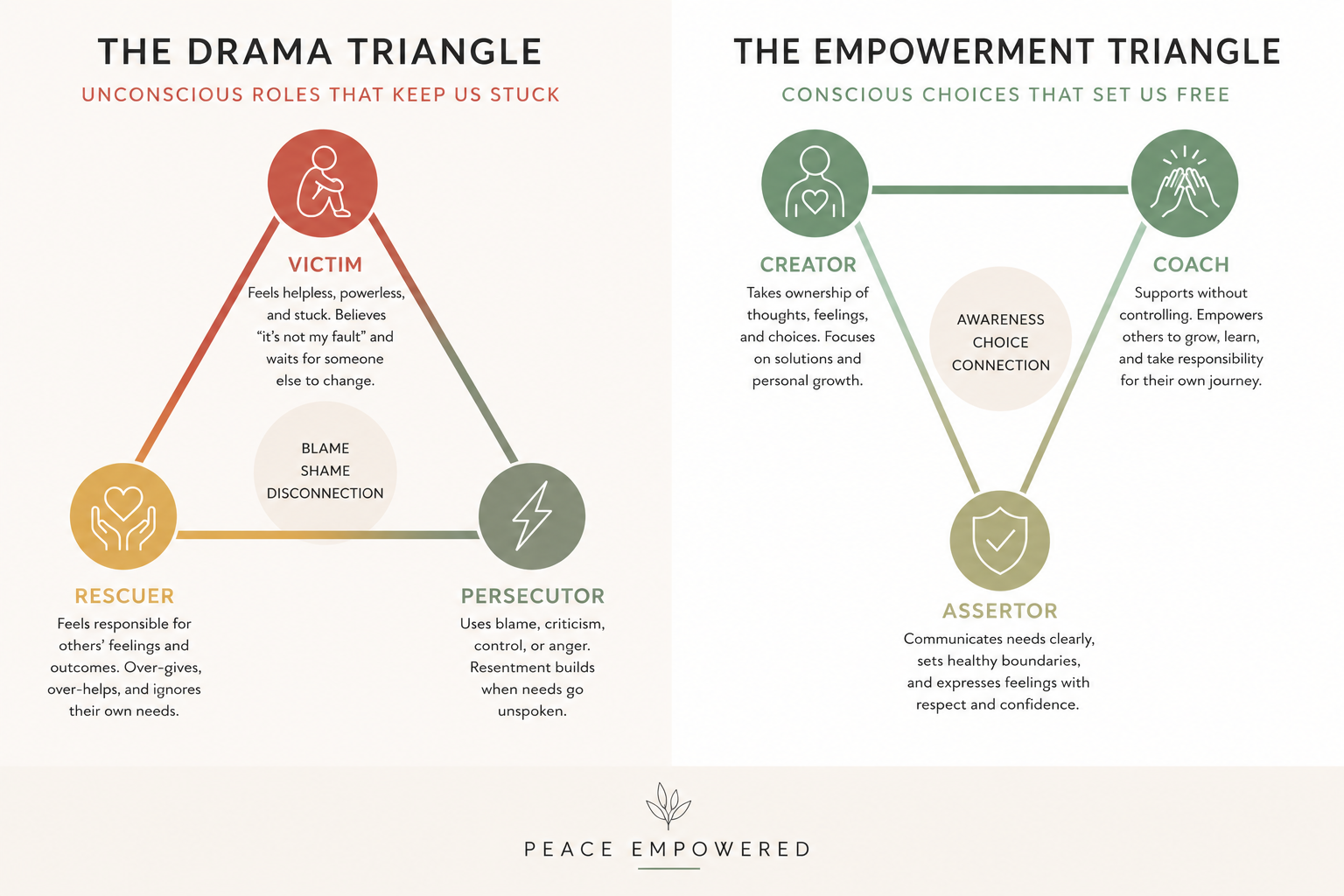
Many people unconsciously move through what is known as the Drama Triangle—a relational dynamic made up of three roles:
The Victim
The Rescuer
The Persecutor
These roles often develop as protective responses rooted in childhood experiences, attachment wounds, trauma, people-pleasing, codependency, or environments where emotional safety and healthy boundaries were inconsistent.
Understanding these patterns is important because self-awareness is one of the first steps toward healing.
The Victim
When someone is operating from the victim role, they may feel helpless, emotionally overwhelmed, unsupported, misunderstood, or stuck.
This can sound like:
“Why does this always happen to me?”
“Nobody understands me.”
“If this person would just change, things would finally get better.”
Victim consciousness can leave a person feeling emotionally trapped and disconnected from their own ability to create change. While pain, trauma, and difficult experiences are very real, remaining identified with helplessness can unintentionally keep people stuck in cycles of suffering, avoidance, fear, or emotional dependency.
Healing requires compassion for our pain while also taking accountability for our healing.
The Rescuer
The rescuer often feels responsible for fixing, saving, helping, or emotionally carrying others.
On the surface, rescuing can appear loving or supportive. However, underneath the behavior there is often anxiety, fear of rejection, guilt, hyper-responsibility, difficulty with boundaries, or a learned belief that love must be earned through caretaking.
Many rescuers learned early in life to focus on other people’s emotions while disconnecting from their own needs.
Questions to reflect on:
Why do I feel responsible for other people’s outcomes?
Do I struggle to trust others with their own growth process?
Have I learned to equate love with self-sacrifice?
How often do I abandon myself while trying to help others?
Sometimes rescuing unintentionally disempowers the very people we are trying to help. When we constantly over-function for others, we may stop trusting in their ability to problem-solve, grow, regulate emotions, or navigate challenges independently.
Healthy support empowers.
Rescuing creates dependency.
There is a difference between walking alongside someone and carrying them.
The Persecutor
The persecutor role often develops when unresolved resentment, emotional exhaustion, frustration, or unmet needs remain unaddressed for long periods of time.
This can present as:
Criticism
Blame
Defensiveness
Anger
Emotional withdrawal
Control
Harsh communication
Many people who enter the persecutor role have ignored their own emotional needs, lacked boundaries, or overextended themselves for so long that resentment begins surfacing through reactive behaviors.
Underneath anger is often hurt, burnout, disappointment, fear, or abandonment of self.
How the Cycle Plays Out
Consider a relationship between Jane and John.
Jane feels emotionally unsupported and begins operating from the victim role:
“I feel alone in this relationship.”
John responds by trying to fix everything. He over-functions emotionally, takes responsibility for Jane’s feelings, and steps into rescuer mode.
Over time, John becomes emotionally depleted and resentful. Eventually, frustration builds and he becomes reactive, critical, or emotionally withdrawn, shifting into the persecutor role.
Jane now feels even more hurt and misunderstood, which deepens her feelings of victimization.
The cycle continues.
Many couples, families, friendships, and workplace dynamics move through this pattern unconsciously.
Moving Beyond the Drama Triangle
Healing begins with awareness, not shame.
The goal is not to judge ourselves for these patterns, but to recognize them with honesty, compassion, and accountability.
As individuals develop greater self-awareness, emotional regulation, and healthier boundaries, they begin moving out of survival-based relational dynamics.
This often includes:
Learning to tolerate discomfort without rescuing
Taking responsibility for emotions without blaming others
Developing healthier communication
Setting boundaries without guilt
Reconnecting with personal needs and identity
Allowing others to experience consequences and growth
Letting go of control
Building trust in self, others, and God
Growth occurs when we stop asking:
“How do I control this situation or person?”
And begin asking:
“What is this pattern trying to teach me about myself?”
True healing is not about becoming perfect.
It is about becoming conscious.
Ready to Begin Your Healing Journey?
At Peace Empowered, we help individuals identify unhealthy relational dynamics, strengthen emotional awareness, establish healthier boundaries, and heal patterns rooted in trauma, anxiety, codependency, and relational wounds.
Healing requires both compassion and accountability.
You are not defined by your past patterns, but healing does require the willingness to become aware of them, take responsibility for your growth, and begin responding differently.
Peace Empowered, LLC
In-Person & Telehealth Sessions Available in Georgia & Florida